This is a hard question to answer – but at the same time easy in the sense of Kafka’s place in societies constructs, minds and imagination. When starting with the task at hand of addressing – who was Franz Kafka, you should begin with picturing a man peering from his window on Niklas Street, Prague – watching the world go by – there he would write.
Whenever I read Kafka’s stories you can always gain a sense of location – this is truly vivid in Metamorphosis (1915); as Gregor Samsa realises he has indeed been transformed into some ‘thing’ else, that is a beetle. The majority of the novel takes place within a small room, as Samsa bares witness to his life falling apart around him – as his Manager and family struggle to cope with his inability to work and resume his usual duties. But this story is so much more than a man metamorphosing, this is a story with subtext that beautifully shines a light on oppressive bourgeois behaviours and Kafka’s introspective sadness in his failure to please his father. Relatable? Yes, so many of us can see the patterns of Kafka’s stories repeating themselves – I always picture the workers scene in Fritz Laing’s Metropolis and reflect on the mechanical movements of the workers, unable to sustain their energy, as a dangerous unknown fluid rises – they become more frantic but their positioning of the dials on the clocks is uneven/inaccurate – they die – and are replaced; and this is exactly what happens to Gregor Samsa when he is replaced by his sister Greta. His work has a place within arguably different movements, to include both surrealist and expressionistic ideas, manifesting themselves in the maggots eating away at the human condition.
As The Writer’s Mark evolves many people have reached out to share their connection to the writer and his tormented honesty. Kafka wrote beautifully subjective letters that often presented his deliberation in confronting a specific problem or idea. Although some of Kafka’s letters were kept and preserved in the Kafka museum, so many were lost or destroyed.
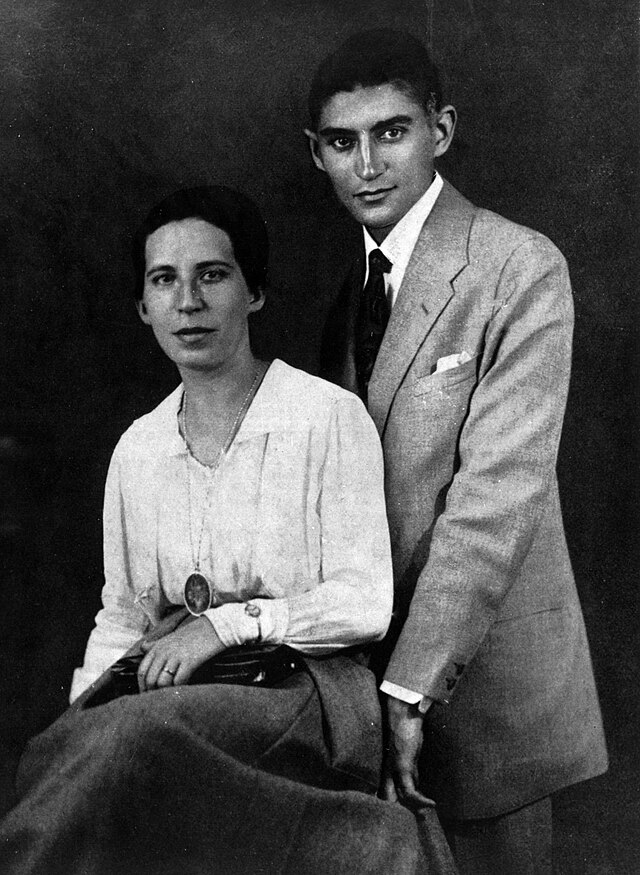
What is clear is Franz Kafka was a romantic, but the thoughts of such ‘what could be’ were the thoughts which kept him from embracing love. You can read ‘Letters to Felice’; a collection of letters that Kafka wrote for one of his lovers – a turbulent on/off relationship that eventually ended for good in 1917 after Kafka’s deteriorating health; contracting tuberculosis. What is clear from Kafka’s diary entries and letters was his unwavering curiosity for Felice, describing their first encounter in a very unflattering/disconnected fashion, ‘I alienate myself from her a little by inspecting her so closely…Unattractive hair, strong chin.’ Franz Kafka. This quote resonates with me and the short story ‘Rejection’ from Contemplation. The words within this story allow Kafka to be completely observant and brutally honest with his observations of the woman that belittles the gentleman in the story.

 thewritersmark.co.uk